
IRS 2026 Portugal: Key Tax Deadlines in 2027
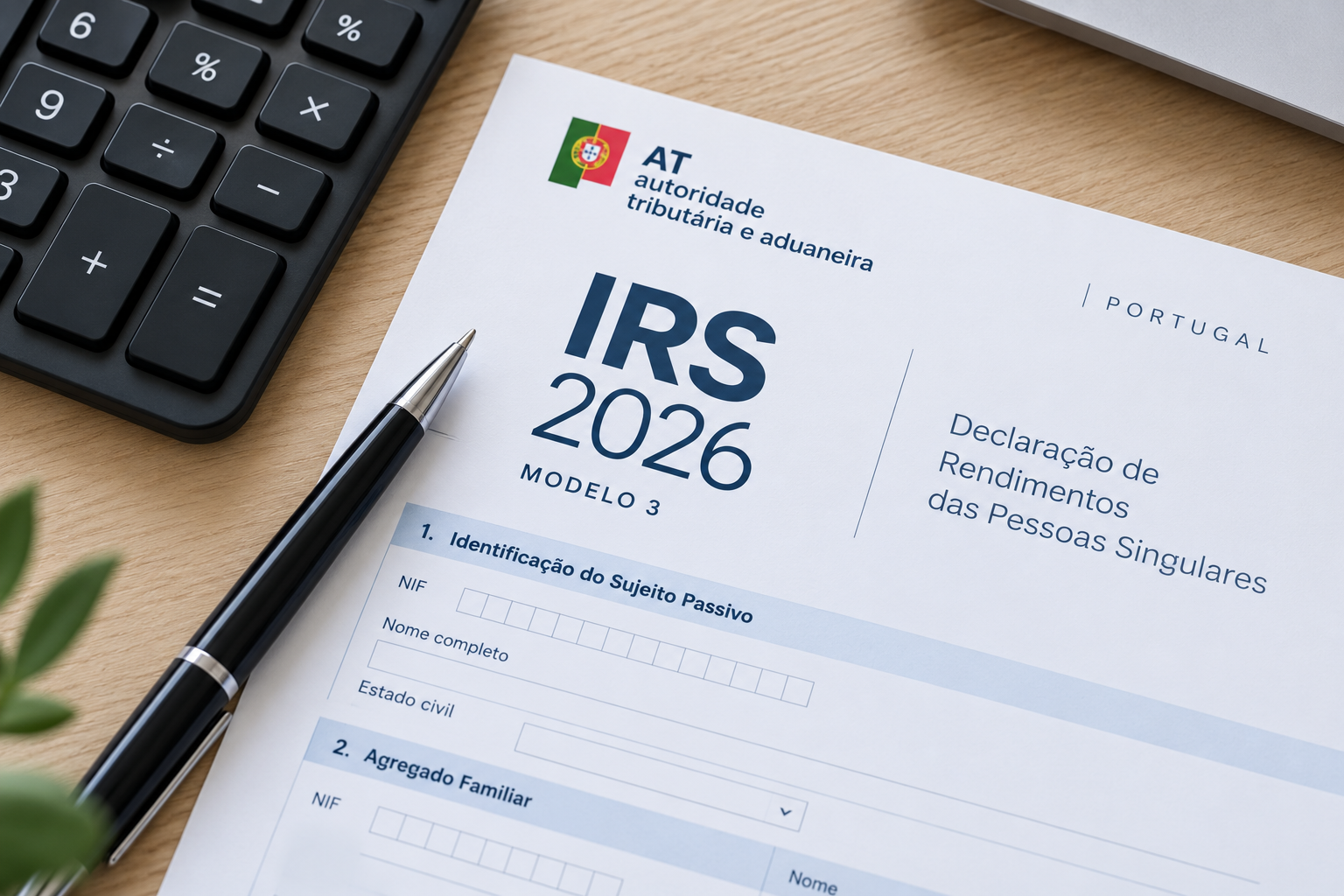
If you were a tax resident in Portugal during 2026, your Portuguese personal income tax return — known as IRS (Imposto sobre o Rendimento das Pessoas Singulares) — will generally be filed in 2027.
The actual IRS filing period is only part of the process. Several important deadlines occur before April, including the validation of expenses in e-Fatura, confirmation of your household composition and other tax-related communications.
For expats and international taxpayers, additional care may be required where you have foreign employment income, pensions, dividends, interest, investment accounts, capital gains, rental income, self-employment income or other income outside Portugal.
Below is our timeline of the main IRS 2026 deadlines to meet in 2027.
Last updated: October 2026.
The Portuguese Tax Authority has not yet published its complete 2027 annual tax calendar. The dates below are based on the rules currently in force and the existing IRS timetable. We will update this guide if the Tax Authority announces any changes.
IRS 2026 Deadlines in 2027: Quick Overview
| Deadline | What you may need to do |
|---|---|
| 15 February 2027 | Report qualifying long-term residential lease contracts or their termination |
| End of February 2027 | Validate e-Fatura expenses, update household information and complete other pre-filing communications |
| 16–31 March 2027 | Review IRS deductions calculated by the Tax Authority |
| 31 March 2027 | Deadline for advance IRS/IVA allocation to an eligible organisation |
| 1 April–30 June 2027 | Submit your 2026 Portuguese IRS tax return |
| 31 August 2027 | Normal deadline for payment or refund for returns filed on time |
Important note on the February deadline
Under the current rules, several obligations must be completed by the end of February.
Because 28 February 2027 falls on a Sunday, the practical deadline is expected to move to the following business day, Monday, 1 March 2027, subject to confirmation in the official 2027 Tax Authority calendar.
1. By 15 February 2027 – Long-Term Rental Contracts
Property owners with qualifying long-term residential rental contracts should communicate the duration of the contract, or its termination where applicable, through the Portal das Finanças.
This communication can be relevant to the tax treatment applicable to qualifying long-term leases.
If you are a landlord in Portugal, do not wait until the annual IRS filing period to review this obligation.
2. By the End of February 2027 – e-Fatura, Household and Other Communications
For most taxpayers, some of the most important IRS work happens before the tax return can even be filed.
Validate your e-Fatura expenses
Check the invoices recorded under your NIF in the e-Fatura portal.
You should verify whether:
- all relevant invoices have been reported;
- invoices requiring additional information have been completed;
- expenses are allocated to the appropriate category;
- professional or business expenses have been correctly identified where you are self-employed.
Correct classification can affect the deductions available in your IRS calculation.
Update your household composition
Check that your agregado familiar reflects your situation on 31 December 2026.
This is particularly important if during 2026 you:
- married or divorced;
- entered or ended a recognised partnership;
- had a child;
- experienced a change in custody arrangements;
- had another relevant change in household composition.
Incorrect household information can affect your tax return, deductions and whether joint taxation is available.
Dependent students
Where applicable, dependent students earning Category A employment income or Category B professional income may need to confirm their student status.
Rental income – Modelo 44
Certain landlords who are exempt from issuing electronic rental receipts, and who have not opted to issue them, must report the relevant rental income through Modelo 44.
Education expenses and relocation to inland Portugal
Certain taxpayers may also need to communicate qualifying:
- education expenses connected with educational institutions in inland Portugal or the Autonomous Regions; and
- rental expenses resulting from moving their permanent residence to qualifying inland areas.
3. By 31 March 2027 – IRS and IVA Allocation
Taxpayers may choose an eligible organisation to receive the permitted allocation of their IRS and/or IVA.
The IRS allocation does not increase the taxpayer’s IRS liability: the designated percentage is taken from the tax that would otherwise belong to the State.
If you do not make the advance selection by the end of March, it may still be possible to make the choice when submitting the annual tax return, subject to the applicable rules.
4. From 16 to 31 March 2027 – Check Your IRS Deductions
During this period, taxpayers can review the deductions calculated by the Portuguese Tax Authority.
Check the amounts attributed to categories such as:
- general household expenses;
- healthcare;
- education;
- housing;
- nursing homes;
- VAT-related deductions;
- other eligible deductible expenditure.
If you identify omissions or inaccuracies, some items can be challenged before the end of March.
For certain expenses, corrections may instead be made through Annex H when submitting the annual IRS return, provided the relevant supporting documentation is retained.
5. 1 April to 30 June 2027 – File Your 2026 IRS Tax Return
The standard period to submit your Portuguese IRS return for income earned during 2026 is:
1 April 2027 to 30 June 2027
The return is submitted electronically through the Portal das Finanças.
Depending on your circumstances, you may either confirm an automatic tax return or submit Modelo 3 together with the relevant annexes.
Important for expats: foreign income must not be ignored
Portuguese tax residents are generally required to report their worldwide income, not only money earned or received in Portugal.
This can include:
- foreign salaries;
- self-employment or consulting income;
- pensions and retirement distributions;
- interest;
- dividends;
- rental income from foreign property;
- share and investment gains;
- other foreign-source income.
Foreign income is generally reported through Annex J.
This does not automatically mean that the same income will be taxed twice. Portugal’s double taxation agreements and the foreign tax credit rules can be relevant where tax has already been paid abroad.
Foreign bank and investment accounts
Portuguese tax residents may also have to identify foreign bank accounts and securities accounts in Annex J, even where those accounts generated no taxable income during the year.
This requirement is frequently overlooked by expats.
Can expats use Automatic IRS?
Not always.
Under the current rules, Automatic IRS is restricted to taxpayers meeting specific requirements, including generally receiving income only in Portugal.
Therefore, taxpayers with foreign income will normally need to submit Modelo 3 and the appropriate annexes, rather than relying on Automatic IRS.
Special Rule: Foreign Tax Not Yet Determined by 30 June
There is an important rule that can be particularly useful for international taxpayers.
Where a Portuguese tax resident has foreign-source income and the amount of foreign tax eligible for double-taxation relief has not yet been determined by the normal Portuguese filing deadline, Portuguese law may allow the IRS filing deadline to be extended until 31 December.
However, this is not an automatic extension simply because you have foreign income.
The taxpayer must meet the legal requirements and communicate the relevant situation to the Portuguese Tax Authority within the normal filing period.
For taxpayers with income from countries whose tax filing calendars do not align with Portugal’s — including the United States in certain situations — this provision should be reviewed carefully.
6. By 31 August 2027 – IRS Payment or Refund
For IRS returns submitted within the normal legal deadline, 31 August 2027 is generally the relevant final date for the Tax Authority to process the resulting refund or for the taxpayer to make the required payment.
Do not assume that receiving no communication means that no tax is due.
After filing, taxpayers should monitor their Portal das Finanças account for the assessment notice (nota de liquidação) and any payment reference issued by the Tax Authority.
IRS in Portugal for Expats: Common Issues
International taxpayers often have a more complex Portuguese tax return than someone whose income arises entirely in Portugal.
Particular attention may be required if you:
- became or ceased to be Portuguese tax resident during 2026;
- are a U.S., UK, Canadian or other foreign national living in Portugal;
- receive pensions or retirement distributions from abroad;
- own an LLC, corporation or other foreign business;
- work remotely for a foreign employer;
- provide services to foreign clients;
- receive dividends or interest through foreign brokers;
- sold shares, cryptocurrency or other investments;
- sold property in Portugal or abroad;
- receive foreign rental income;
- hold foreign bank or investment accounts;
- benefit from the original NHR regime or another special Portuguese tax regime;
- may qualify for IFICI (sometimes referred to as NHR 2.0).
The correct Portuguese treatment depends not only on where the money was paid, but also on your Portuguese tax residence, the nature and source of the income, applicable Portuguese tax law and any relevant double taxation agreement.
Documents Expats Should Start Collecting Early
Do not wait until June to start preparing your Portuguese tax return.
Depending on your situation, you may need:
- Portuguese employment and withholding statements;
- recibos verdes and self-employment records;
- foreign salary statements;
- pension and Social Security statements;
- annual brokerage statements;
- dividend and interest reports;
- details of investment purchases and sales;
- foreign rental income and expenses;
- details of property sales;
- foreign tax returns and proof of foreign tax paid;
- IBAN/BIC details for foreign financial accounts;
- documentation relating to NHR or other special tax regimes.
Starting early is particularly important where foreign brokers or tax authorities only issue final statements several months after the end of the year.
Need Help Filing Your 2026 IRS in Portugal?
International tax returns can become significantly more complex when foreign income, pensions, investments, companies or different tax systems are involved.
Portugal Taxes specialises in assisting expats and international taxpayers with Portuguese taxation.
Our team can assist with:
- Portuguese IRS preparation and filing;
- foreign income and Annex J;
- U.S.–Portugal and other cross-border tax matters;
- pensions and retirement income;
- self-employment and foreign clients;
- investment income and capital gains;
- Portuguese property income and sales;
- NHR and IFICI-related matters;
- partial-year Portuguese tax residency;
- review and correction of previous Portuguese tax returns.
Where appropriate, we also coordinate with foreign tax professionals so that the Portuguese and overseas tax positions can be considered together.
Do not leave your 2026 IRS preparation until the final weeks of June.
Talk to Portugal Taxes
If you have foreign income or a cross-border tax situation, contact our team to discuss how we can assist with your 2026 Portuguese IRS return.
FAQs About IRS 2026 Tax Deadlines in Portugal
When do I file my 2026 Portuguese tax return?
Income earned during 2026 is normally declared between 1 April and 30 June 2027.
What is the IRS deadline in Portugal in 2027?
For the 2026 tax year, the standard deadline to submit Modelo 3 is 30 June 2027.
When should I validate my 2026 e-Fatura invoices?
Under the current rules, e-Fatura validation must be completed by the end of February 2027. As 28 February falls on a Sunday in 2027, the practical deadline is expected to be 1 March 2027, subject to confirmation by the Tax Authority.
Do Portuguese residents have to declare foreign income?
Yes. Portuguese tax residents are generally taxed on and required to report their worldwide income, subject to the applicable exemptions, special regimes, tax treaties and double-taxation relief.
Do I need to declare my foreign bank accounts?
Portuguese residents who are holders, beneficiaries or authorised signatories of qualifying foreign bank or securities accounts generally have to identify those accounts in Annex J, even if the account generated no income.
I paid tax abroad. Do I also pay tax in Portugal?
Not necessarily twice.
The correct treatment depends on the type of income, the country concerned, Portuguese law and the applicable double taxation treaty. In many situations, foreign tax can be taken into account through a foreign tax credit.
I have NHR. Do I still need to declare foreign income?
Potentially exempt income is not necessarily income that can simply be omitted from the Portuguese tax return.
The applicable NHR treatment should be analysed according to the type and source of the income and the relevant tax treaty.
Need Help With Your 2026 Portuguese IRS Return?
If you have foreign income or a cross-border tax situation, contact Portugal Taxes to discuss how we can assist with your 2026 Portuguese IRS return.
Disclaimer:
This website is for informational purposes only and does not constitute legal, tax, or financial advice. Individual circumstances vary, and we recommend consulting a qualified professional before making any tax-related decisions. PortugalTaxes.pt is not affiliated with the IRS, Portuguese Tax Authority, or Portal das Finanças. PortugalTaxes.pt is not affiliated with the IRS or Portuguese Tax Authority.